V4 Bevel and Hardwood Grades, Explained
V4 Bevel and Hardwood Grades Explained
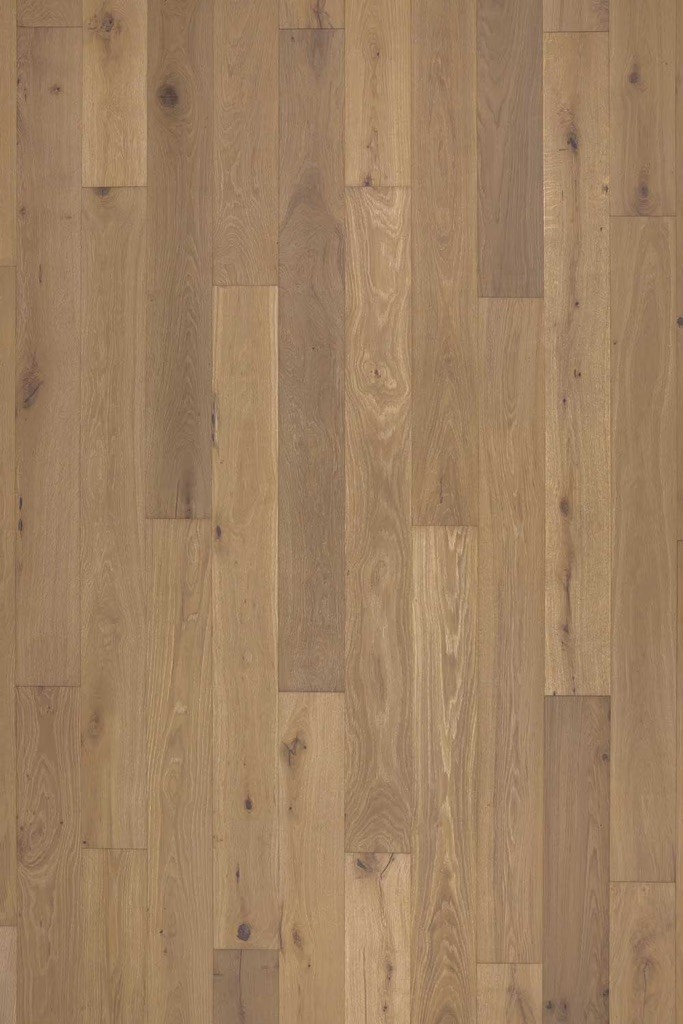
Short answer: V4 refers to a bevel on all four edges of a plank — a small chamfer that creates a defined groove between boards. V2 is bevelled on the two long edges only. The bevel visually separates each plank, emphesising the wide-plank format and hiding minor height differences between boards.
What the V number means
The "V" describes how many edges of a plank are bevelled.
V0 — square edges, no bevel. Boards meet flush, producing a continuous surface. Demands a very flat subfloor.
V2 — bevelled on the two long edges. The plank's length is defined; the ends run flush.
V4 — bevelled on all four edges. Every plank is fully outlined as its own board.
A bevel is a small angled chamfer, typically 1–2 mm, milled along the edge. When two planks sit side by side, the two chamfers form a shallow V-shaped groove.
Why manufacturers use V4
It celebrates the plank. In a wide-plank floor, the size of each board is the point. A V4 bevel outlines every board so the eye reads the format immediately. Without it, a wide floor can look like an undifferentiated field of wood.
It hides tiny height differences. No subfloor is perfectly flat and no plank is perfectly uniform. A square-edge floor shows a 0.5 mm height difference as a visible ridge you can feel underfoot. A bevel absorbs it into the shadow line.
It accommodates seasonal movement. Wood moves. In dry winter months, boards contract slightly. On a square-edge floor, that shows as a thin gap. On a V4 floor, the movement is invisible inside the groove that was always there.
It is the European convention. The look most people associate with European wide-plank flooring includes the bevel. It reads as intentional craft rather than as a seam.
Practical considerations
The groove collects a little dust, which a vacuum handles easily on a normal cleaning schedule — the concern is often overstated. In a commercial setting with heavy grit, square-edge or micro-bevel is sometimes preferred.
Reading a hardwood grade
Grade describes natural character in the wood, not quality. A higher grade is not a better floor — it is a different look, and it is the single biggest driver of price.
Select / Prime — minimal knots, tight uniform color. Formal, calm, most expensive.
Natural — moderate character, some small knots, mild color variation.
Character / Rustic — knots, mineral streaks, wide color variation from board to board. The most natural-looking and the most forgiving in a busy household.
Character grade is what most contemporary wide-plank flooring uses, because a wide board with no figure in it looks strangely empty — and because the variation is what makes a real wood floor unmistakably not a printed one.
How to read a spec sheet
When comparing two wide-plank floors, these are the lines that matter:
Pavilion Manor's spec: engineered European White Oak, 8.66-inch wide planks, V4 bevel, character grade with natural color variation, brushed texture.
Explore Pavilion Manor
Frequently asked questions
What does V4 mean in flooring?
The plank is bevelled on all four edges, creating a defined groove around each board. V2 is bevelled on the long edges only; V0 has square edges with no bevel.
Is a bevelled edge better than a square edge?
Neither is better — they are different looks. Bevelled edges emphasise the plank format and hide minor height variation and seasonal movement. Square edges give a smoother, more continuous surface but demand a flatter subfloor.
Do bevelled edges collect dirt?
A small amount of dust settles in the groove, and normal vacuuming removes it. It is a minor consideration in a residential setting.
What does character grade mean in hardwood flooring?
It means natural features — knots, mineral streaks and colour variation from board to board — have been left in rather than sorted out. It is a deliberate aesthetic choice, not a quality defect.

Jeff Garber
Flooring Expert
Next posts