UV-Cured vs Oiled White Oak Finishes: Durability, Look, and Upkeep
UV-Cured vs Oiled White Oak Finishes
5 min read
November 18, 2026

Short answer: Oiled finishes penetrate the wood, giving a matte, tactile surface that is spot-repairable but needs regular re-oiling. UV-cured urethane finishes are hardened at the factory, resist wear with almost no routine upkeep, and are refinished rather than re-oiled. For busy households, UV-cured is the lower-maintenance choice — Pavilion Manor uses a high-performance UV-cured, open-grain finish for exactly that reason.
What each finish actually is
An oiled finish (natural or hardwax oil) soaks into the top of the wood and cures within the fibers. The protection lives in the wood itself, which is why oiled floors feel raw and look ultra-matte.
A UV-cured urethane finish is applied at the factory and cured instantly under ultraviolet light, cross-linking into a hardened layer bonded to the board. The protection sits with the wood rather than merely on it, and it arrives at full hardness — no on-site curing period, no waiting to move furniture in.
The case for oiled floors — honestly
Oiled finishes earn their following:
Depth. Oil saturates the grain, producing a warmth and low sheen many designers love.
Spot repair. A scratch can often be buffed and re-oiled locally, without touching the rest of the room.
Patina. The floor evolves visibly with use and care.
The trade-off is a real maintenance relationship: dedicated soaps, periodic re-oiling (more often in kitchens and hallways), and vulnerability to spills and neglect between treatments. An oiled floor rewards an owner who wants to tend it — and punishes one who forgets.
The case for UV-cured finishes
Factory-hardened durability. Curing under UV light produces a tougher, more consistent surface than any site-applied finish, with performance verified before the plank ever ships.
Minimal routine care. Dry sweeping or vacuuming and prompt attention to spills is the regimen. No re-oiling schedule, no specialty soap cabinet.
Consistency. Every plank leaves the line with the identical finish build — no lap lines, no thin spots, no installer variability.
Long service life. When the surface eventually shows its decades, the floor is refinished rather than re-oiled — which is why a generous wear layer matters (Pavilion Manor's is 3mm, sawn).
The honest limits: UV-cured finishes are not spot-repairable the way oil is — deep damage means board replacement or a refinish — and cheaper versions can look plastic. That last point is a manufacturing choice, not an inherent one, which brings us to texture.
Can a UV-cured floor still look natural?
Yes — if the finish is built for it. The plastic look people associate with urethane comes from thick, glossy films that fill the grain. An open-grain UV-cured finish does the opposite: it protects the wood while leaving the pores open, so you see and feel real oak texture underfoot. Combined with a matte sheen, a well-executed UV-cured floor reads remarkably close to an oiled one — with a fraction of the upkeep.
Upkeep, side by side
Oiled: dry sweep; clean with finish-specific soap; re-oil periodically; spot-repair scratches locally.
UV-cured: dry sweep or vacuum; wipe spills promptly; no wet or damp mopping — water is wood flooring's enemy regardless of finish; refinish once, far down the road, instead of re-oiling for years.
Either way, the environment matters more than the cleaning: keep the home between 35–50% relative humidity and 60–80°F year-round. Pavilion Manor requires a humidifier or dehumidifier where the climate demands it — outside that range, the warranty is void, whatever the finish.
Who should choose which
Choose oiled if you want a living surface, accept a maintenance ritual, and value local repairability above all.
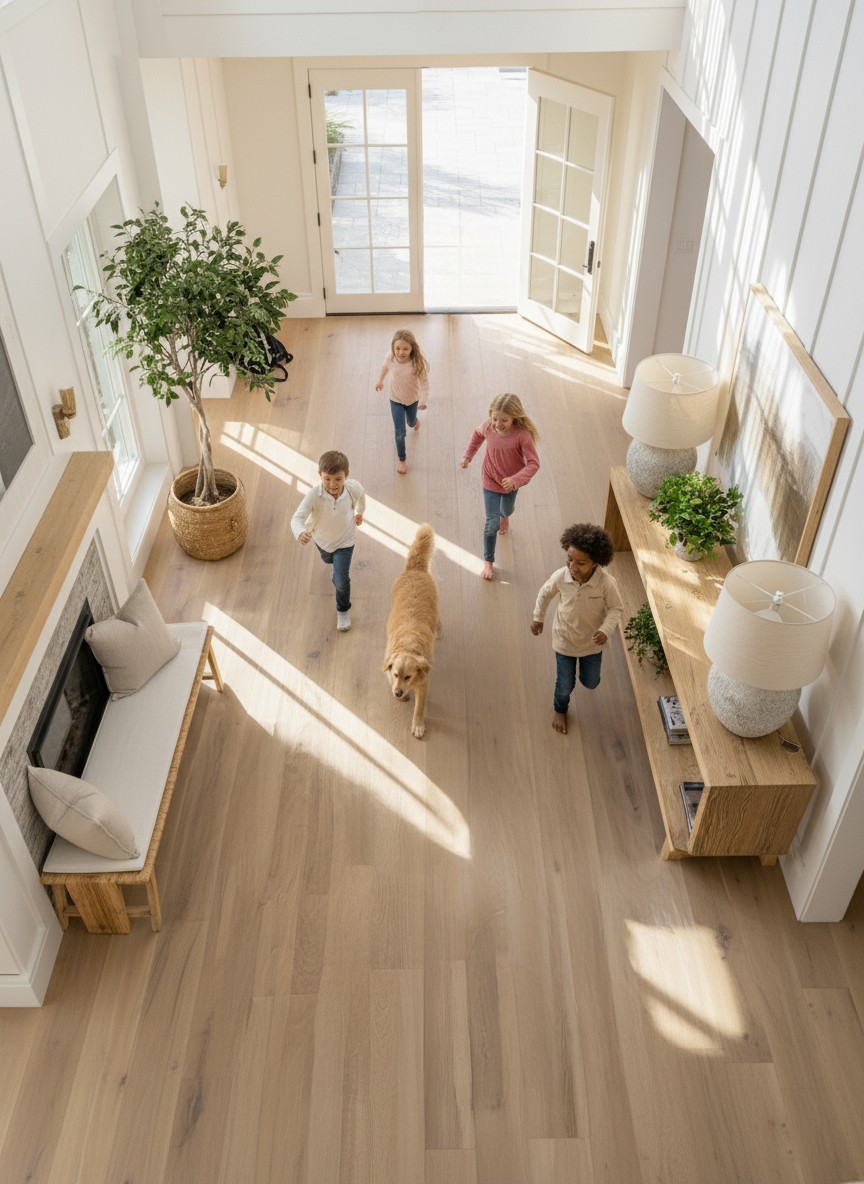
Choose UV-cured if the floor needs to perform in a full household — kids, dogs, dinner parties — without a care calendar. For most busy luxury homes, and for designers who will not be there to supervise maintenance after handoff, UV-cured is the specification that still looks right in year ten.
Pavilion Manor's approach
Pavilion Manor finishes its engineered European White Oak with a high-performance UV-cured, open-grain finish over thermal-treated, Character-grade planks — 5/8" thick, 8.66" wide, lengths up to 87". The result is the tactile, matte character designers want from oil with the resilience of a factory-cured surface, backed by a 30-year residential finish warranty and 10-year commercial finish warranty, plus lifetime structural coverage for the original owner. The line is FloorScore and GREENGUARD certified with no added formaldehyde, and is installed by licensed contractors to NWFA standards via full-spread glue-down or nail-down with glue-assist.
Frequently asked questions
How do I clean a UV-cured white oak floor?
Dry methods only: sweep, dust mop, or vacuum with a hard-floor head, and wipe spills as they happen. Do not wet or damp mop — standing moisture damages wood flooring and is excluded from warranty coverage.
Can a UV-cured finish be re-oiled later?
No. Oil cannot penetrate a cured urethane surface. When a UV-cured floor eventually needs renewal, it is sanded and refinished — Pavilion Manor's 3mm sawn wear layer is sized to allow that.
Is a UV-cured finish safe for indoor air quality?
Factory curing means no on-site finish fumes, and Pavilion Manor is FloorScore and GREENGUARD certified with no added formaldehyde.
Does the finish warranty cover radiant-heat homes?
Pavilion Manor's warranties — 30-year residential finish, 10-year commercial, lifetime structural for the original owner — are material-only and non-transferable, and damage caused by radiant heat is not covered. Review site conditions with your dealer and installer before specifying over radiant systems.
Feel the open-grain difference yourself — find a Pavilion Manor dealer near you.
Keep reading
What Is Thermally Treated White Oak Flooring? Heat, Color, and Stability Explained
Is Your Hardwood Floor Safe to Breathe Around? What Indoor Air Quality Means for Your Home
Character-Grade White Oak, Explained: Knots, Variation, and Why Designers Choose It
Explore Pavilion Manor: See all 10 colors · Find a dealer

Jeff Garber
Next posts