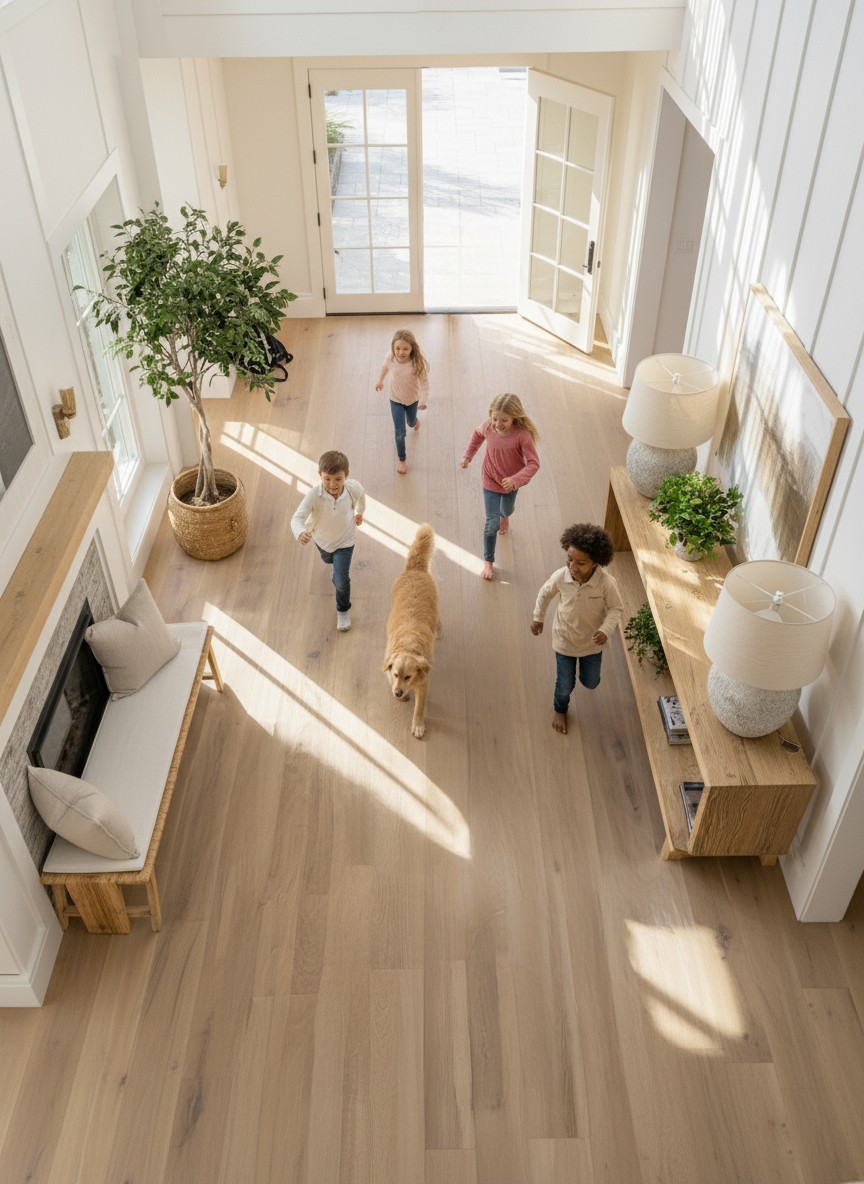
Glue-Down vs Nail-Down vs Floating: How Engineered Hardwood Should Be Installed
Glue-Down vs Nail-Down vs Floating Engineered Hardwood
5 min read
November 18, 2026

Short answer: Engineered hardwood installs three ways — glued to the subfloor, nailed to it, or floated above it — and the method changes how the floor feels, sounds, and ages more than most buyers expect. Pavilion Manor specifies full-spread glue-down or nail-down with glue-assist, installed by a licensed contractor to NWFA guidelines. Here is what each method actually does, and why a wide-plank oak floor earns the fastened approach.
The three methods, in plain terms
Full-spread glue-down bonds every plank to the subfloor with a troweled adhesive layer — the floor becomes part of the structure. Nail-down fastens planks through the tongue into a wood subfloor; with glue-assist, adhesive is added so each board is both nailed and bonded. Floating connects planks only to each other over an underlayment, resting on the subfloor without attachment — the standard method for laminate and rigid-core vinyl, and an option some engineered wood brands allow.
Why attachment changes how a floor lives
A fastened floor — glued, nailed, or both — cannot move independently of the structure beneath it. Underfoot, that reads as the dense, dead-quiet footfall people associate with traditional hardwood: no hollow note, no flex, no drum-like resonance over small subfloor dips. A floating wood floor, however well installed, carries some of the acoustic signature of the air gap beneath it and moves as one large panel with the seasons, which is also why wide, long planks — where small movements multiply across big boards — favor fastening. Pavilion Manor's wide-plank European White Oak is specified glue-down or nail-down with glue-assist for exactly these reasons.
Full-spread glue-down: when and why
Glue-down is the method of choice over concrete slabs (where nails are not an option) and anywhere acoustics matter most — the continuous adhesive bed damps sound into the structure. It demands the most of the subfloor: flat within NWFA tolerances, dry by moisture test, and clean enough for the adhesive to bond. Done right, it produces the most monolithic result of the three. It is also the least forgiving of shortcuts, which is one reason Pavilion Manor requires licensed professional installation rather than treating it as a weekend project.
Nail-down with glue-assist: the wood-subfloor standard
Over plywood or OSB, nail-down is fast, proven, and mechanically strong — and adding glue-assist closes the method's one historic weakness, the micro-movement at fasteners that can become squeaks years later. The adhesive bead bonds each plank to the subfloor between nails, so boards cannot work loose or creak against their fasteners. For wide planks, glue-assist is not an upgrade; it is the correct spec, and it is how Pavilion Manor's installation guidelines read.
The honest paragraph: this is not a DIY floor
Pavilion Manor requires installation by a licensed contractor following NWFA guidelines — with pre-installation inspection of the boards, because installation constitutes acceptance. Proper acclimation, subfloor moisture testing, racking the V4 color variation across the field, and troweling adhesive at the right spread rate are craft, and the warranty is built on that craft. If click-together weekend installation is a priority, a floating rigid-core product is the honest answer; a fastened wide-plank oak floor is a trade-in of convenience for permanence. The environment requirements also apply from day one: 35–50% relative humidity, 60–80°F, with a humidifier or dehumidifier in the home.
What each method means for repairs later
Attachment also decides how the floor is serviced decades from now. A fastened floor is repaired the way traditional hardwood always has been: a damaged board is cut out and a new one is glued in by a professional, invisibly, without disturbing the field around it — and the whole floor can be sanded and refinished within the wear layer's thickness when the day comes. A floating floor must often be unclicked back to the damaged plank from the nearest wall. Permanence cuts both ways, and for a floor meant to outlast its first owners, the fastened repair model is the right one.
Questions to settle with your installer before day one
Subfloor: concrete or wood? That alone usually decides glue-down versus nail-down with glue-assist.
Moisture: what did the subfloor test read, and is it documented before the first board goes down?
Flatness: has the subfloor been checked against NWFA tolerance and corrected where it misses?
Acclimation and layout: how long will the boards sit on site, and how will light and dark V4 boards be blended across rooms?
Transitions and perimeter: where do expansion gaps, thresholds, and vents land, and who supplies the matching trim?
Frequently asked questions
Can Pavilion Manor be installed as a floating floor?
No — the specified methods are full-spread glue-down or nail-down with glue-assist, installed by a licensed contractor to NWFA guidelines. The fastened spec is what delivers the floor's footfall, acoustics, and long-term stability at wide plank widths.
Which is better over concrete: glue-down or floating?
For engineered hardwood, glue-down — nails are not an option in concrete, and a full adhesive bed gives the most stable, best-sounding result. The slab must pass a moisture test first, and your installer should document the reading.
Why do installers add glue to a nail-down install?
Glue-assist bonds each plank to the subfloor between fasteners, eliminating the micro-movement at nails that becomes squeaks and creaks years later. On wide planks, where seasonal movement per board is larger, it is the professional standard.
How long does engineered hardwood need to acclimate before install?
Until the boards reach equilibrium with the home's lived-in conditions — your installer confirms with moisture readings rather than counting days. That is also why the home should already be holding 35–50% humidity and 60–80°F before installation starts.
Ready to plan a fastened wide-plank install? Review the installation instructions, browse the colors, or find a dealer.
Keep reading
Explore Pavilion Manor: See all 10 colors · Find a dealer

Jeff Garber
Next posts